

Hey! Welcome back to the Creator Economy NYC newsletter, your weekly hit of insights and strategies to help you build, monetize, and scale as a creator.
Tru Narla (known as @mewtru) is a software engineer-turned-creator who builds electronics for fun. A mini e-reader in a tin case. A compass that points you to the nearest Taco Bell (yes, really!).
Now one of those builds, a flower-shaped camera, has sold out its first production run in preorders, and she's planning to build from there.
It's a fascinating example of what's possible with a creator business. Tru is just chasing what she loves, and the fact that she gets paid for it is pretty awesome.
We sat down with Tru to understand how a creative side project becomes a product and then becomes a business and how to build alongside your audience.
Let's get into it.


Two minutes. A chance to win $150. 🎁
Earning money from your creator work? We want to hear how you manage it.
Complete our 2-minute survey for a chance to win one of three $150 B&H gift cards. Three winners will be selected at random.
Whether you’re just starting out, creating alongside a day job or doing it full-time, your experience belongs in this report. Individual responses stay anonymous in everything we publish.

Your audience is already telling you what to build.
Tru started streaming on Twitch during the pandemic, while working as a software engineer, as a way to get better at coding. Building projects live gave her a reason to keep learning. Those clips became her first short-form content, and almost three years ago she went full-time.
At the end of last year, she started teaching herself electronics, mostly for fun. She calls what she the focus of her content "aesthetic girly versions of things that already exist."


"It's so cool that I get to build stuff as my job. That's like always what I wanted. I think the content is actually my least favorite part.”
The results so far:
This year, she's made more than she did as a software engineer
Most of her revenue comes inbound through brand sponsorships, from AI companies to Fortnite.
Her first product was close to covering its first production run within 4-5 days of pre-orders
None of it started with a business plan. Here's how a just-for-fun side project turned into a product, and how to run the same play with your own audience.
Build what you'd want, not what you think will sell
"I'm just building stuff that I want," Tru told us. For example, she found a small circular screen and wondered why she hadn’t seen a camera built around one.
The first version barely worked but opened her mind to what she could build.
Over roughly four months, she kept developing the idea. One version sat on her wrist like a watch. Then she modeled a flower-shaped body around the round display.
It looked cute and felt good in her hand. So she made a video and it went a little viral.
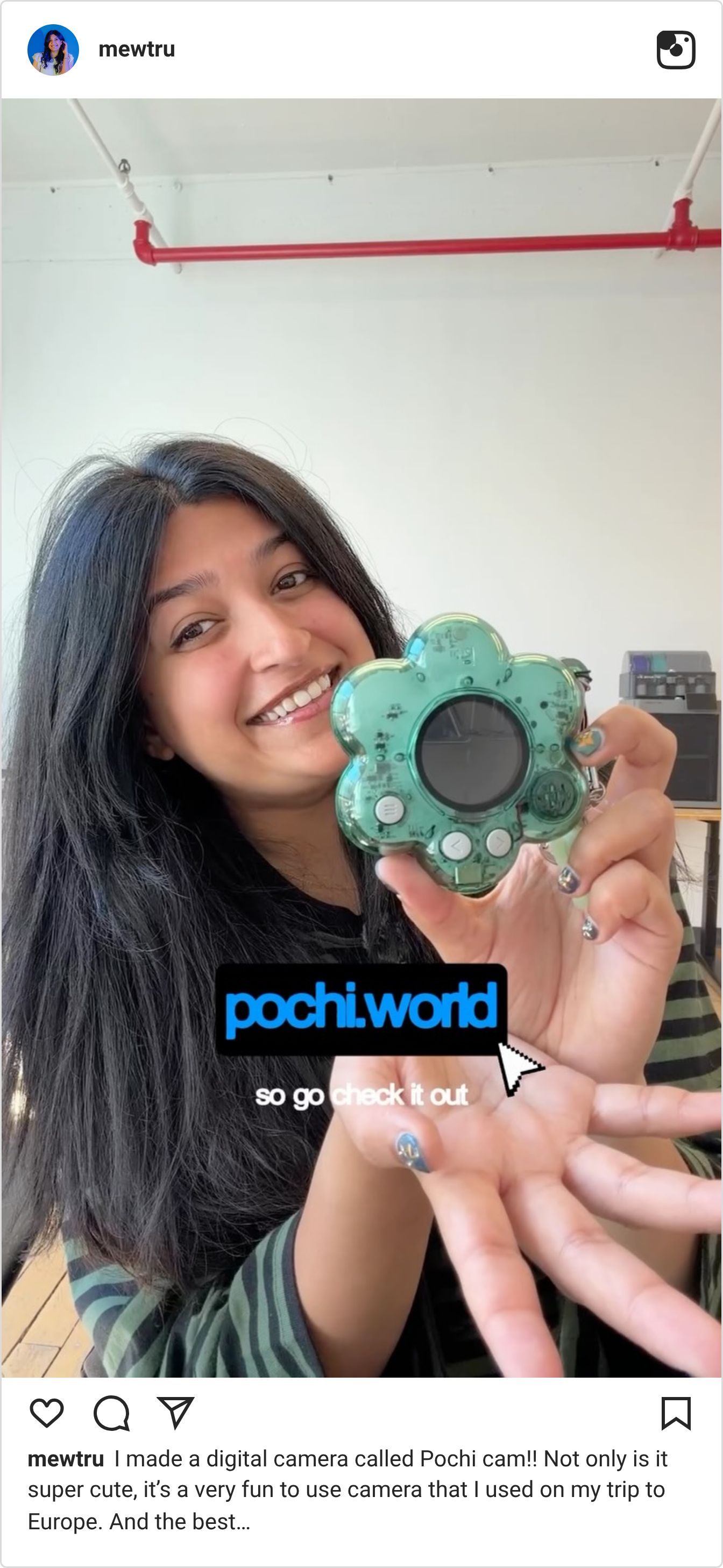
That video also reached a company that helps connect product developers with manufacturers. They approached her about turning the prototype into something she could produce and sell.
Tru supplied her code and design files, worked with the team on production, and visited China to see the process firsthand.
And thus a hardware product was born: she’s calling it the Pochi Cam, a small flower-shaped digital camera that clips onto a bag.

The comments are helping shape the product
Once people could see the camera, they had opinions.
“Please make a blue one!” “I need this in pink” “Make a printer so we can print the photos!” Her audience basically told her what to build next (and what they’d buy) in the comments. (Oh, shoutout Siftsy for that).

Which also speaks to how important it is to listen to what your audience is telling you in the comments section!
“I think it’s really cool as an audience person too, just to be like, wow, she’s listening to me and taking my opinion.”
For anyone building a product (whether digital or physical), there’s a good lesson here:
A question worth asking your own audience:
“What would you want to know or change before you bought this?”
Then came the test: would people pay?
Tru’s creator business was funded almost entirely by sponsorships when we spoke. She estimated they accounted for about 99% of her revenue.
The camera introduces a completely different line of business: manufacturing, inventory, packaging, shipping, and customers expecting a physical product. Her manufacturer required a minimum order quantity. She said that within four or five days of opening preorders, she was close to covering the cost of that first batch.
The results were still early but encouraging: preorder revenue already helped her break even before product was available. She’s still working through packaging and the keychain, improving the checkout experience, and learning how to use paid ads.
Even the platform response surprised her. She expected the camera’s aesthetic to work especially well on Instagram. TikTok was driving much of the inbound interest.
The audience gave her a head start, but she’s still had to learn how to turn attention into orders and deliver the product.
🔒 Don’t fuhgeddaboudit: Watch what people do at each step. Views show interest in the content. Questions reveal what matters to potential buyers. Orders test the offer.
Taste and personality 🤝 audience
Tru didn’t begin by asking her followers what they’d buy, but instead she created products that were fun to create and used and then listened to how her audience responded.
Tru already has plenty of ideas of her own. She wants to explore another e-reader, more electronics, and even fashion products with a playful twist.
What connects them is her unique taste and personality.
“This product is like… me as a product.”
That also explains why she spends time answering comments and questions. People know who’s making the thing. She wants to be present for the people buying it.
Steal this: The build-alongside-your-audience playbook
If you want to build anything (from physical products to software and anything in between!) you can run a version of this ‘build-alongside-your-audience’ playbook.
1. Make something specific
Start with something you wish existed or an existing product you’d change. Tru’s starting point was a circular screen. Yours might be a sketch, a sample, or a rough working version.
Ask: What can I make that lets someone experience the idea?
2. Show the work
Share the prototype, the design decision, or the part you haven’t solved. Give people enough detail to have a useful opinion. A video of the product in someone’s hand can answer questions a polished announcement won’t.
Ask: What would someone need to see to understand why this is interesting?
3. Listen for patterns
Keep track of repeated questions and requests. Separate things that help someone understand the product from changes that require making a different one.
10 people asking about the same color deserves a closer look, whereas one person requesting five new features doesn’t have to become your roadmap.
Ask: What keeps coming up, and can I test it?
4. Test the offer
Test out a specific version, price, and next step in front of people. A waitlist can help you learn who wants updates. A paid preorder tests something more concrete, provided you can clearly explain what buyers will receive and when.
Ask: What evidence do I have beyond people liking the idea?
5. Repeat with the audience
Show what you changed, what you’re still figuring out, and what you decided to leave for later. Once products arrive, find out how people actually use them. Their experience can inform the next version.
Ask: What did I learn that should change what I make next?
Every step of this loop gives you something to build with: a reaction, a preference, an order, or real customer experience. From there, you keep building 💪
Thanks to Tru for sharing her story. You can follow her here and explore Pochi Cam here.

December 9th - Closing out the year with our biggest ones yet
We're finalizing our final event of the year. Yup… we’ve made it that far.
While more details are coming soon, you can get ahead and apply to join below.

Two free tools top creators use to keep themselves moving

The Creator Goal Setting Guide (FREE): A simple but powerful document to help you declare who you want to BECOME in 2026. Get it here.
The Creator Accountability System (FREE): Your visual companion for consistent creation in 2026. Get it here.

Thanks for reading! If you’ve been sitting on a product idea, show someone the version you have.
Give them one specific question to answer. Then use what you learn to make the next version better.
F*ck It, Create It,
Brett and Taylor
